Research
Research across the full wireless sensing pipeline.
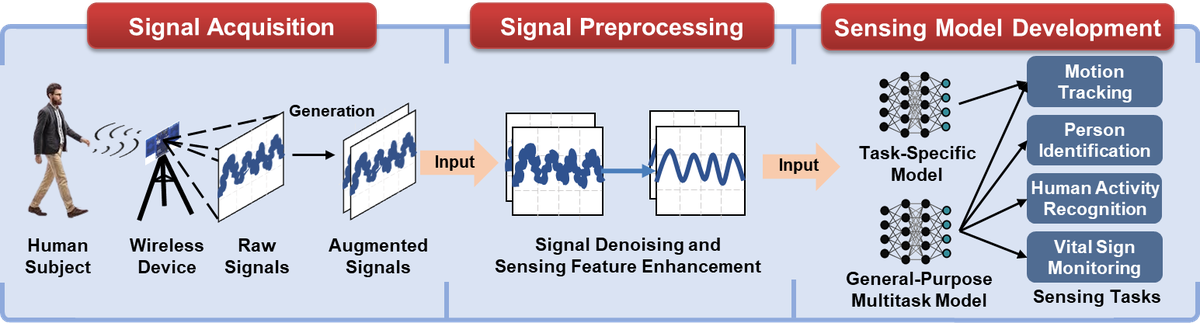
Wireless sensing uses changes in wireless signals caused by the human body to track movement, identify individuals, recognize activities, and monitor vital signs. The sensing pipeline consists of three stages: signal acquisition, signal preprocessing, and sensing model development. My research spans all three stages, addressing data scarcity, signal quality, and generalization across environments and tasks.
- Signal acquisition: Captures signals shaped by interactions with people and their surroundings. Signal generation complements data collection by creating additional training samples.
- Signal preprocessing: Suppresses noise and enhances task-relevant features to provide more informative inputs for sensing models.
- Sensing model development: Uses these inputs to build task-specific or general-purpose multitask models for motion tracking, person identification, human activity recognition, and vital sign monitoring.
Signal Acquisition: Acquire and augment wireless signals
IEEE TWC 2026 · IEEE GLOBECOM 2023
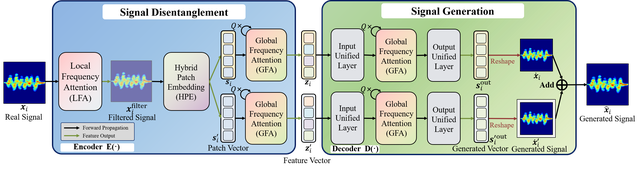
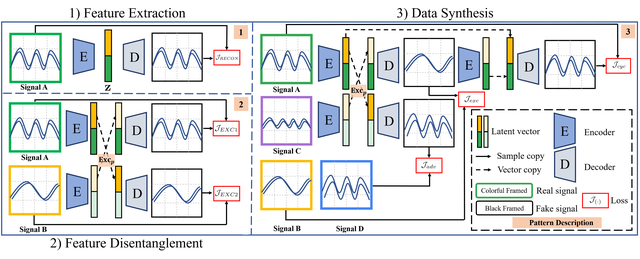
Collecting wireless signals across people and environments is costly. We disentangle human-related and environmental factors to generate signals for combinations not observed during data collection. These synthetic signals expand training data and improve sensing performance.
Signal Preprocessing: Suppress noise and enhance task-relevant features
IEEE IoTJ 2025
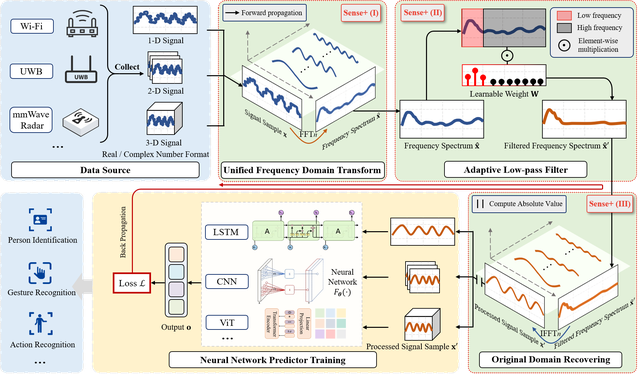
Effective sensing depends on the quality of the input signals. We use task-adaptive low-pass filtering to suppress noise and enhance motion-related features. The resulting plug-and-play module integrates with neural networks across wireless protocols and sensing tasks.
Sensing Model Development: Build task-specific and general-purpose models
IEEE TMC 2025
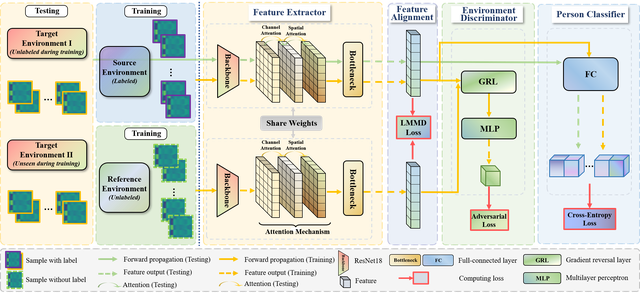
Beyond signal quality, sensing models must remain reliable when their deployment environment changes. We combine IR-UWB radar with transfer learning to learn representations that generalize across environments, improving privacy-preserving person identification.
Qiyuan National Laboratory · Research internship · 2025-06–2025-12
Alongside task-specific sensing, we investigate how a single pretrained model can support multiple communication tasks. Our physics-informed wireless foundation model combines physics-guided masking with physics-inspired network modules. Pretraining on 80 million samples from 14 datasets supports adaptation to eight communication tasks.